Showing posts with label EFL LIFE. Show all posts

2/03/2015

1/30-31 BEING A KANAZAWA-ER


Reflection:
Jan 30. Fri.
Taiwan Hour (Class B&C)
After listening to our advice on the previous day, the high school did some revision on the Taiwan Hour procedure, and the efficiency was amazing. (i was SO IMPRESSED.) The activity went very successfully.

*Revision of the first class*
1. Move to a bigger classroom.
2. Sit in a triangle seat arrangement: easier for everyone to see and listen to the presentation.
3. Use big posters to show seat arrangement, procedure, and topics of each group.
4. Self-introduction of Taiwanese teachers to the whole class moves to the beginning.
5. Time controlled by one teacher.

The event was reported in the newspaper :D


For dinner, Mr. Takahashi took us to a very nice sushi restaurant. I LOVE IT! The seafood was so fresh! (Kanazawa is famous for its seafood.) It was interesting to have dinner with Japanese teachers.
I found Japanese people very thoughtful.
1. Mr. Takahashi prepared a list of questions in both Japanese and English to make small talks with us.
2. The other two teachers from the high school ordered two plates of the same sushi for us, one with wasabi and the other without. Just because my friend and I wanted to have the same sushi but I want it with wasabi and she didn't want it.

Jan 31. Sat.
Experience as a KU student: breakfast at the K convenience store and lunch at the school cafeteria.

Experience as a tourist: city excursion with KU students and high school students.
21st Century Museum of Contemporary Art--> 兼六園 (金澤神社)--> 金澤城

1. In the museum, we saw an exhibition about how Japanese rebuilt their hometown after the 311 earthquake. The concept is "home for all." They invited citizens to join the project because these would be their homes in the future. This reminds me of Finnish community. No matter how old you are, as long as you're the citizen in the community, you're part of it, and you have a say in the community projects.
2. One student told me that 兼六園 was the park of a king. This garden is huge and full of cherry blossom trees without any flowers. I can imagine how pretty it'll be when spring comes! Living in a country with four distinctive seasons is so nice <3 金澤神社 is famous for the study god. We went there and performed their traditional rituals, which was really interesting.
3. 金澤城 is the old castle where KU once located. Very spacious, very impressive, but most of the students were freezing to death (including us...), so we didn't really see much in it.

All the people we met here are kind and friendly, it's easy to get along with Japanese people and I really enjoyed each day we spent here :D

1/31/2015

1/28-29 KANAZAWA HIGH SCHOOL


Reflection:
Jan 28. Wed.
Some thought-provoking ideas from the talk with the principle of Kanazawa High School.
1. Ask students to write some questions after the lesson on a small piece of paper. The questions will be a quiz for other classmates. If the question is good, the teacher will include it in the mid-term exam. Everyone works hard on the questions.
2. Autonomy: Students are more willing to make effort to clean the school if they're going to wear slippers in the school. 
3. Why do Taiwanese teachers use microphones? They want to make sure everyone can hear them, but is teaching only about teachers' "show and tell"?
4. Newspaper test: Every class gets 6 types of newspaper every day. And every week, students have to take a test on current news. The test is a competition between classes and the student who gets the highest scores will be awarded.
5. There are two blackboards in the classroom, one in the front, the other at the back; one is for teaching, the other is for discussion.

We observed an English class with exchange students in the afternoon:
Procedures:
1. Students sit in groups with 2-3 exchange students.
2. They have a worksheet to work on: How much is .... in your country?
3. When time is up, exchange students move to a different group.
4. Students continue to ask the rest of the questions.
Notes:
1. Teaching can be done as a big class; practice can be done in small groups.
2. The person who leads the discussion in small groups should be well-prepared (in this case, the exchange students with better lg proficiency).
3. Ask more open-ended questions.
4. Tasks should be cognitive challenging for perception, but suitable for production. 
5. Tasks should have clear goals.
6. Worksheet is simple and easy to fill in.
7. Spend short time on instruction.
8. Comprehension check: Q: Are we on the same page? Am I making sense? Am I clear?

Japanese English textbook:
1. Topics are more local (Japanese).
2. The layout: Reading--> Comprehension Qs--> Grammar--> Activities
3. There is no Vocabulary section. All definition are written in the margin only.

Jan 29. Thu.
We participated in Taiwan Hour, which is an activity that these students will do with Taiwanese students. The Japanese students researched on a topic to compare Japan and Taiwan and they made posters to display. There are some questions they want to ask TW students and we try to help them with their presentation and answer the questions. There is a check sheet that both the students and us have to complete.
Procedure (in groups):
0. Teacher gives instruction on the procedure.
1. Students sit in groups. 
2. Self-introduction as ice-breaking.
3. Start the poster presentation.
4. QA section.
5. Advice from us.
6. Advice from peer (L1 allowed).

Check sheet:
1. Notes and suggestions for each presenter.
2. Advice for the group as a whole.
3. Advice for the activity as a whole.


1/28/2015

1/26-27 ARRIVED AT KANAZAWA, JP!


Reflection:
Jan 26. Mon. Rainy.
A warm welcome from three Japanese teachers and three KU students greeted us at the airport. It was a rainy and cold day (for us...). The weather was bad but our spirits were high. After one hour of driving, we arrived at the hotel and had a very nice reception dinner with so many teachers--principle of the high school, teachers from the high school, and professors from the university. The dinner was lovely. We were seated between teachers and all the teachers tried to make small talks with us. The topics ranged from education to 巧連智. LOL so much fun.

Jan 27. Tue. Snowy.
Our first time at AHS. A Chinese third grader introduced the campus for us. We were amazed by how clean their school was--take off your shoes and put on slippers before you leave! The umbrellas were neatly stored in rows; the heavy coats were hanged at the back of the classrooms; the restrooms were so dry...And strange thing is that you don't get hot water here. 
Our first interaction with the Japanese students was Tony's Taiwan Hour. The students looked interested but most of them were too shy to speak (same thing in TW). Some of them asked their classmates next to them if they could not understand, and some nodded their heads a lot. 
Lunch with Class C, one of the three classes (first grade), was fun. Each of us had to sit with one group (about 7 ppl), and we chatted about school life, Taiwan, how much freedom they enjoy at their school, etc. 
At night, when all of us were about to pass out (discussing Taiwan Hour), it started to snow!!!! Honestly, snow looked like shaved ice and tasted like water...


10/21/2013

10/21 BACK TO NCCU

10/21 第二次返校座談

今天的主題很不錯,教甄分享!
然後三個學姊有兩個都是一月才開始衝教檢,讓我放心許多...哈哈
但聽說還是冒險,所以我有警惕一下,準備每天固定抽空念書!


綜合三位學姊的分享筆記:

1. THINK:
不一定要成為老師。
非成為老師不可的理由。
有夢就去追,不要覺得累。
自勝者強。
生命是一種長期而持續的累積過程。
用最低的姿態,學習最多的事情。

2. STUDY:
考古題可能有錯!
來源:志光、阿摩、高普考的教育行政題目
PPT實習教師板
一邊代課,一邊念書
念太累可以看"教師天地"等期刊

3. LEARN:
班級經營-->上課規定
辦研習的整套流程
導師就是導演
走自己的風格(溫柔/威嚴)
排座位:空白座位表讓學生寫自己的座號,每個人抽號碼看坐到哪個位置
家長聯絡要做紀錄
活動表格製作(掃除工作、校慶等)
找實習學校幫忙練模擬面試

4. TEST:
寫作要點:
列點(顏色)、層次、具體例子、生活化教學舉例、出題(有目的)、適當的比較
試教:主題要深入、大方向小地方
結構呈現、前後呼應、問題設計、寫作提醒、閱讀策略、細膩闡釋、講述層次 (eg. vocab--> grammar--> reading)、生命教育

9/16/2013

9/16 BACK TO NCCU/ DINNER WITH 組長

9/16 久違政大 & 明曜古拉爵


今天沒有去仁愛,回政大!

跟葉潔宇老師還有第四組的同學分享這兩個月的實習心得。

以下是筆記


1. 體育班學生可以教實用的英文:因為他們可能常出國比賽,可以訓練聽機場、火車的廣播等。

2. 要跟實習輔導老師學如何備課。
3. Reading 要教的是:topic, sentence, main idea, organization.
4. 黑板板書的分割方法。
5. 可以把訂正改成用念單字的!
6. 要想帶每個活動背後的目的。
7. 訓練自己不管是單字、文法、句型都能想出一個教學活動。
8. 可以閱讀如何教特殊生英文相關paper。

之後的兩小時聽了一場演講,主講人是木柵國中陳麗英校長。


陳木金老師 (左) 陳麗英校長 (右)


Notes:

1. 教育是"成人之美",創造學生成功的經驗。
2. 檢視自己:今天做了明天還"想"做 OR 今天做了明天還"得"做。
3. 創造被需要的價值。
4. 反省自己是不是這種老師
5. 關心十二年國教議題等教育議題。
6. 導師實習學習班級經營,不只用在導師班也用在任課班級。
7. 聯絡簿回覆前不確定可先詢問。
8. 要有原則,亦師亦友。
9. 不要討好學生。
10. 因為付出所以傑出。
11. 要做事但鋒芒別太露。
12. 多參加研習活動。
13. 做別人的工作,練自己的功夫。

回東區路上,搭綠一看到這個告示牌很好玩。

Buckle up or pay up.


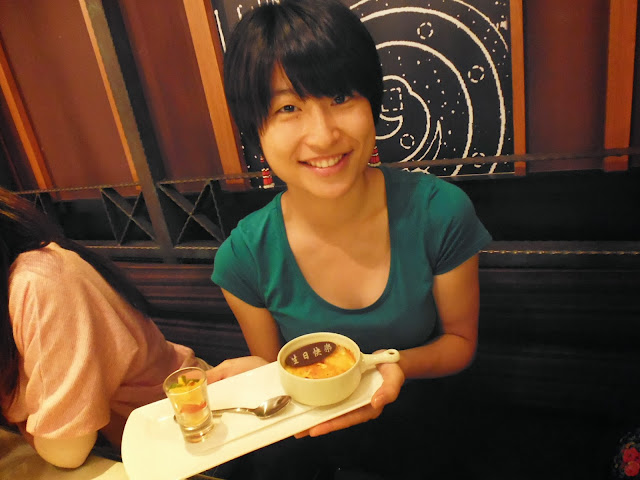
我們實習六人組跟組長一起共進晚餐。因為壽星可以多點一份甜點,所以有生日快樂的巧克力。


跟組長聊了好多不管是實習生活、學校生活、感情、婚姻,組長都有自己的一套見解。
我覺得她講的兩件事滿有道理的:
找對象要找 1. 他愛你比你愛他多。 2. 自己的條件比他好的。
雖然聽起來是有點自私啦。